Meaning & uses
Kyanite Meaning
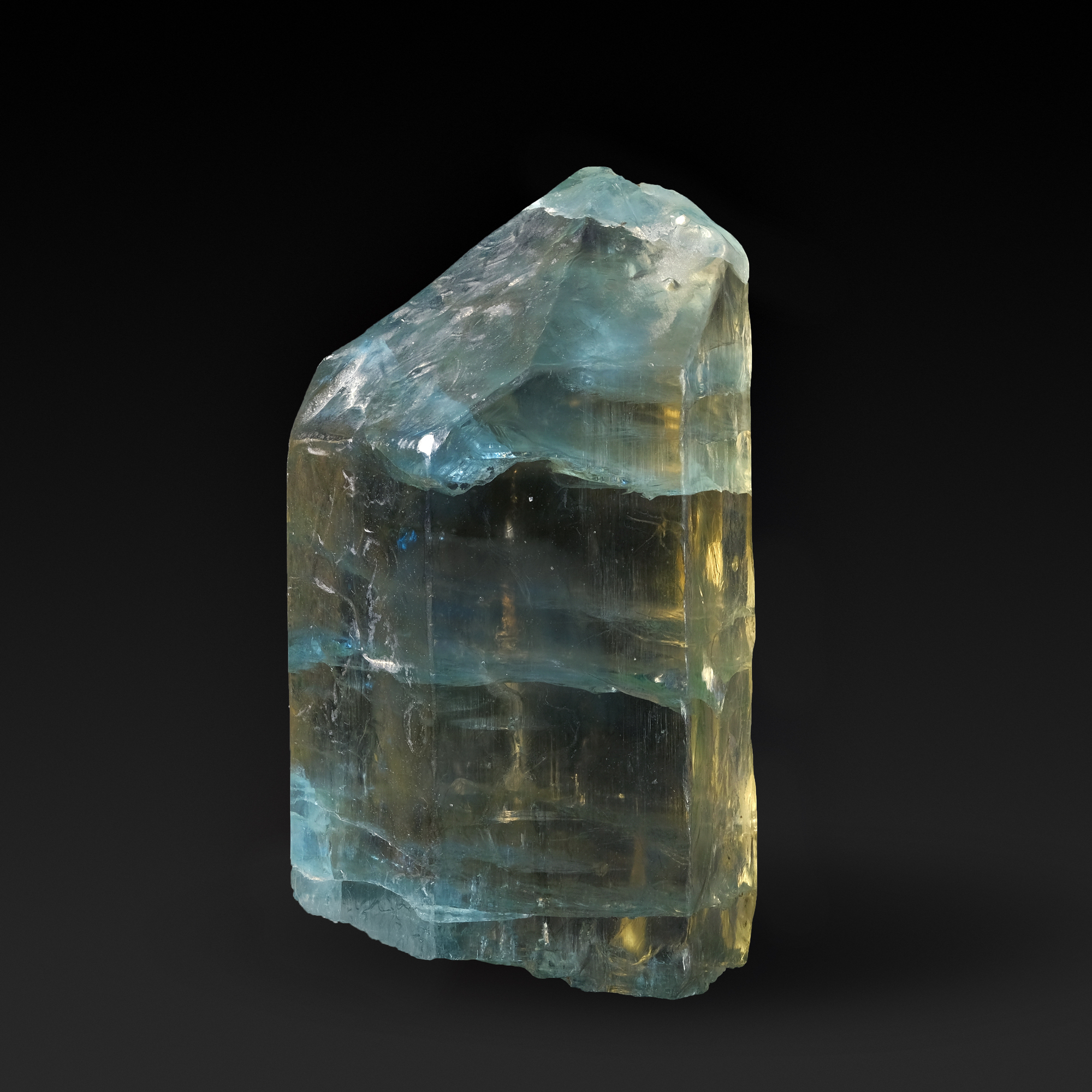
Kyanite's long, blade-like crystals and naturally soothing blue have earned it a reputation as "the bridge stone" — prized for aligning intention with expression rather than pushing either one alone.
What Is Kyanite?
Kyanite is an aluminum silicate, one of three minerals — alongside Andalusite and Sillimanite — that share the exact same chemical formula but form different internal crystal structures depending on the pressure and temperature of the metamorphic rock around them. Geologists actually use which of the three is present in a given rock, or absent, as a tool for reconstructing that rock's deep-earth pressure and temperature history, making Kyanite a genuine scientific indicator mineral as much as a gemstone.
Its name comes from the Greek kyanos, meaning blue — the same root behind the modern word "cyan" — though color isn't Kyanite's most distinctive property. That honor goes to its hardness, which is anisotropic: it genuinely changes depending on which direction you test it, roughly 4.5 on the Mohs scale along the length of a blade but closer to 6.5–7 across it. Early mineralogists found this strange enough that the stone briefly circulated under the name "Disthene," Greek for "two strengths," before "Kyanite" became the standard.
Kyanite typically grows as long, flat, blade-like crystals embedded in metamorphic rock such as schist and gneiss, which is why it's most often sold as raw fanned clusters rather than tumbled or cut stones. Brazil's Minas Gerais region, India, and Nepal are today's major sources, with smaller deposits in the Swiss Alps and the southeastern United States.

A Stone With a History
Unlike Agate or Jade, Kyanite carries no multi-thousand-year carving or amulet tradition — its unusual, direction-dependent hardness makes it a genuinely difficult stone to facet or carve, so ancient lapidary traditions that favored tougher, more predictable material largely passed it over. Its documented history is mineralogical rather than ceremonial: it wasn't formally named and described until the late 18th century, once European mineralogists began systematically cataloguing rock-forming minerals.
Kyanite's real historical impact has been industrial rather than symbolic. Heated to high enough temperatures, it permanently expands and converts into mullite, a dense, heat-resistant ceramic — a property that has made mined Kyanite a genuine industrial commodity for manufacturing refractory bricks, spark plugs, and high-temperature porcelain since the early 20th century, long before it became a fixture of the crystal-healing market.
Meaning and Symbolism
Kyanite's "bridge stone" reputation follows directly from its shape. A long, straight crystal reads naturally as a line connecting two points, and Kyanite's traditional meaning leans on exactly that image — a bridge between what's thought and what's said, between inner insight and outward expression, rather than a stone that pushes either quality on its own.
That reading is reinforced by something else unusual about Kyanite: it's traditionally said to require no cleansing at all, the belief being that it doesn't hold or accumulate energy the way more porous stones can. Whether or not that folklore persuades you, it fits the stone's broader reputation as something that channels and aligns rather than absorbs.
Carried or worn to
- Align thought and speech for clearer communication
- Deepen intuition and inner clarity
- Ease anxiety around expressing a difficult truth
- Support meditation and a settled, focused mind
Chakra, Zodiac & Element
Kyanite is unusual in this directory for being tied to two chakras at once — the Throat and Third Eye — rather than favoring a single one, a direct extension of its bridge reputation that treats clear communication and clear inner perception as one connected process rather than two separate qualities. Its Air element reinforces the same theme, Air being the element of thought, communication, and mental clarity throughout the wider tradition.
Astrologically it's linked to Libra, Taurus, and Aries — Libra for balance and alignment, Taurus for the grounding a naturally airy stone benefits from, and Aries for directness in speaking one's mind.

How to Use and Care for Kyanite
Kyanite's care instructions break from most of this directory because of that same anisotropic hardness: at roughly 4.5 along a blade's length but up to 6.5–7 across it, Kyanite is genuinely soft and prone to splitting in one specific direction, which is why it's rarely cut into rings the way Agate or Jasper are. It suits pendants, earrings, and loose display specimens — settings where a knock along the length of the blade is unlikely — far better than daily-wear rings.
As for cleansing, a brief rinse in room-temperature water is fine, but avoid soaking it or exposing it to sudden temperature swings, which can stress its natural cleavage plane. Given its traditional reputation for not needing cleansing at all, most owners skip water cleansing entirely and simply let the stone be.
Frequently Asked Questions
Why does Kyanite have two different hardness numbers?
Is Kyanite safe to wear every day?
Does Kyanite really never need cleansing?
What chakra is Kyanite associated with?
Can Kyanite get wet?
What's the difference between Kyanite and Sapphire?
A stone that bridges rather than dominates — quiet, aligning, and rarely in a hurry.
Shop this stone